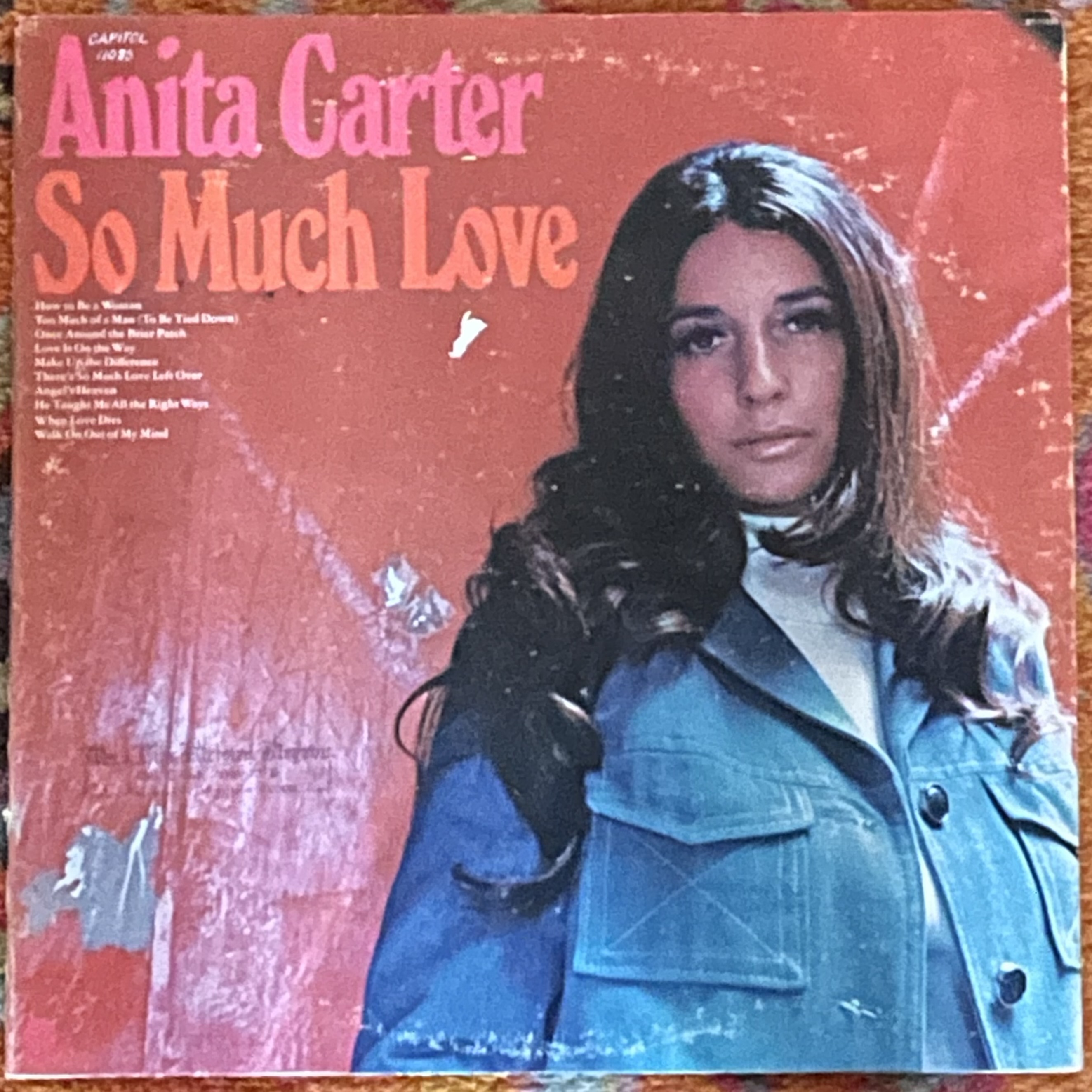
Recently, I was flipping through the racks at a local record store when I came across Anita Carter’s 1972 solo album, So Much Love. Never having heard an album by Anita, I bought it. And I’m glad I did. This $5 record turned out to be a real gem. At its best, it sounds like a cross between Patsy Cline and Dusty Springfield, with a little bit of “Harper Valley PTA” thrown in. It certainly is a product of early 70s Nashville, but it has a touch of Memphis soul, too.
Those who have read my 2022 book, Country Boy: The Roots of Johnny Cash, know I’ve spent a lot of time researching the Man in Black. But you don’t have to be a huge Cash fan to know Johnny was married to June Carter in 1968. Anyone who has seen Walk the Line knows that. But with his connection to June, Cash married into the historic and often troubled Carter family. June and Anita Carter were sisters, part of the second iteration of the Carter Family.
It’s absurd to claim a single person or family “invented” country music, but the Carter family had a huge influence on the popularity of early country music. The original Carter family, who emerged on the scene in 1927, consisted of A.P. Carter, his wife Sarah, and Sarah’s cousin “Mother” Maybelle Carter (and wife to A.P.’s brother, Eck). After the first Carter family broke up, Mother Maybelle carried on with her daughters June, Anita, and Helen. Helen was the oldest and Anita was the baby of the three sisters. Together, the second Carter family toured 1940s America, winning millions of fans, one of whom was the young Johnny Cash.
I have gotten to know June’s music over the years, but not so much Anita’s. Anita was more of a support player throughout her career, though it was not for lack of talent. Chroniclers of the Cash-Carter family agree that Anita had the best voice of the Carter sisters, who supported the Cash road show in the 1960s and 70s. It is Anita that stands out on the classic Johnny Cash gospel track, “Were You There When They Crucified My Lord?” And it was Anita that in 1962 recorded what became known as “Ring of Fire.” Written by her sister, June—with friend Merle Kilgore—the song originally was titled “Love’s Ring of Fire.” Anita’s version is beautiful and folksy. It is not the scorcher Johnny made it a year later when he recorded “Ring of Fire,” complete with mariachi horns.
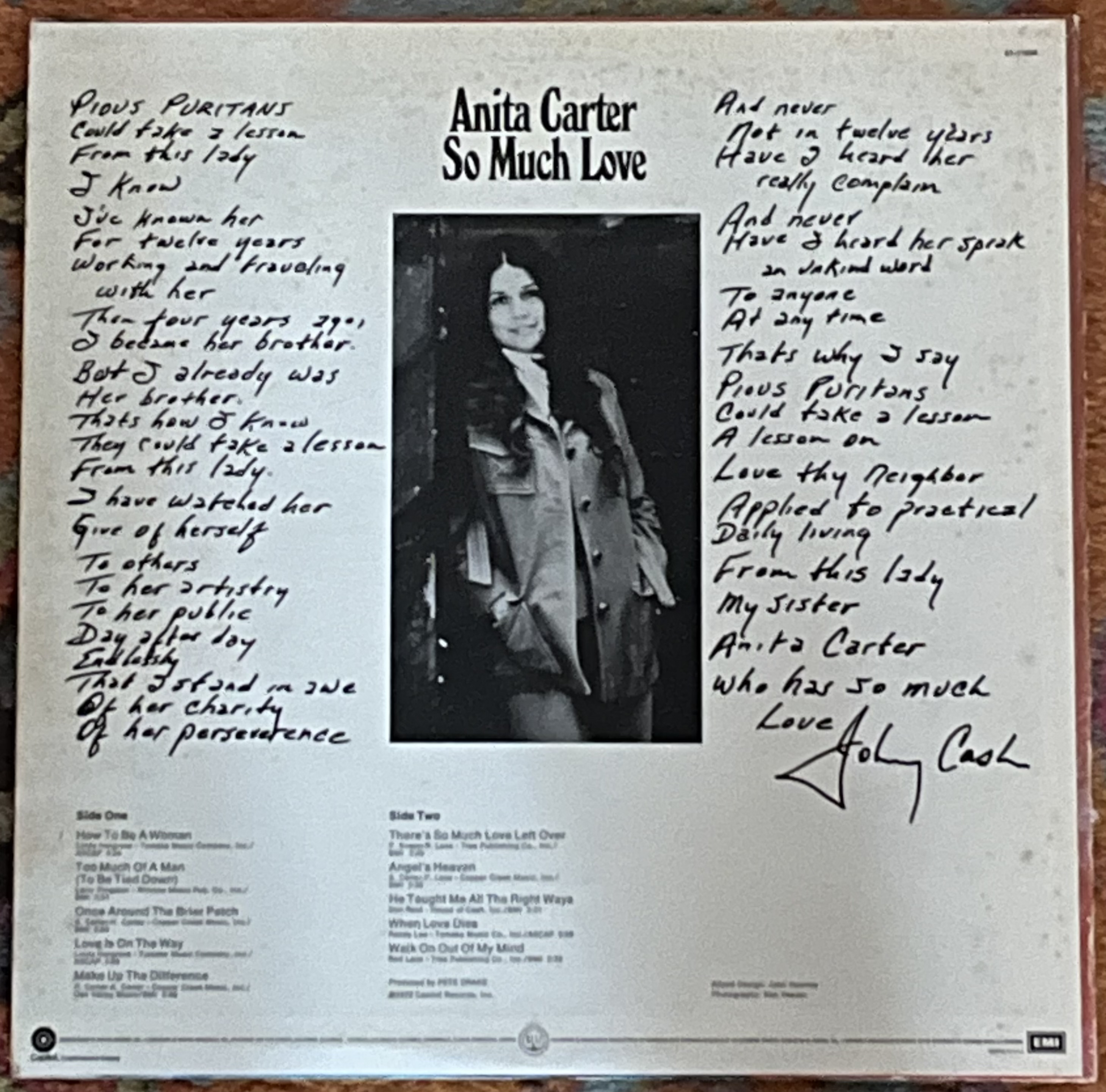
Anita didn’t record many solo albums throughout her career. But she had lots of support for So Much Love. Unfortunately, the session players and singers who joined her for the album are not noted on the LP. One person we know who helped, though, is Johnny Cash, who supplied the liner notes. He wrote:
Pious Puritans could take a lesson from this lady I know. I’ve known her for twelve years, working and traveling with her. Then four years ago, I became her brother. But I already was her brother. That’s how I know they could take a lesson from this lady. I have watched her give of herself to others. To her artistry. To her public. Day after day. Endlessly. That I stand in awe of her charity. Of her perseverance. And never not in twelve years have I heard her really complain. And never have I heard her speak an unkind word to anyone. At any time. That’s why I say pious Puritans could take a lesson. A lesson on love thy neighbor applied to practical daily living. From this lady, my sister, Anita Carter, who has so much love.
Despite the talk of being a “brother” to his “sister” Anita, the love Cash wrote about was not platonic. As Robert Hilburn revealed in his 2013 biography of Johnny Cash, in the early 70s, Cash and Anita were having an affair, one that the Cash inner circle knew about but the public did not. One might wonder what Cash’s ultra-religious fan base—let alone “pious Puritans—might have thought of the affair, let alone “pious Puritans.” Cash, after all, was moving in America’s most celebrated religious circles, having recorded an album with the Rev. Billy Graham a year before Anita’s album came out.
Religious or not, most people would agree having an affair with your sister-in-law is a bad idea. But such was the nature of the Cash-Carter family drama at the time.
Anita, then, had a lot to sing about on So Much Love. Of course, she couldn’t sing about her relationship with Johnny directly. But love was clearly on her mind. It’s not only part of the album’s title, three of the songs have “love” in them—“Love Is on the Way,” “There’s So Much Love Left Over,” and “When Love Dies.” None of these were penned by Anita, but she added songs of her own. “Once around the Briar Patch” and “Make Up the Difference” she wrote with her sister Helen. She also wrote the tune “Angel’s Heaven.”
Country music relies heavily on the family, either as a source of inspiration for songs or in the performances themselves. Sometimes, Nashville literally becomes incestuous, as in the case of the Cash-Carter affair. And while her relationship with Johnny didn’t last, in the 1974, Anita married Johnny Cash’s guitarist Bob Wootton, whom she divorced in 1981.
The sexual drama behind So Much Love is interesting, but what does the record sound like? It is certainly of its time, taking cues from the late-60s, early 70s Nashville sound. But it doesn’t sound dated. Anita is a forceful singer, perhaps at times too forceful. Her producer, Pete Drake, might have had her loosen up a bit on some tracks. Her voice is intense, but not supple. Dusty Springfield, who could belt out a ballad with the best of them, could deliver a terrific vocal that was just above a whisper. Given that the subject of love is front and center, Anita’s album might have benefited from a more intimate, less “Stand By Your Man” approach at times.
While it is not perfect, So Much Love should not be forgotten. Cash family historian Mark Stielper told me Anita was “one of the nicest people I ever met,” but she also suffered from “hard luck.” It would take her more than twenty years to record another solo album. And she died in 1999 at 66.
So Much Love, unfortunately, was not a success upon its release. Looking back, though, it is better than anything Johnny Cash was doing in 1972, and it absolutely deserved a CD release. Apparently, you can’t stream it anywhere. It has even been overlooked by YouTube content creators, who have not uploaded a full version of the album.
While Johnny Cash continues to put out records more than twenty years after his death, the virtual disappearance of So Much Love is further evidence of the fading of the Carter family from public memory. No one has yet written a biography of June Carter, though she was the subject recently of a Paramount+ documentary. Yes, we Mark Zwinitzer and Charles Hirshberg’s 2002 book, Will You Miss We When I’m Gone? about the Carters. But country music historians need to do better. We certainly need to tell the larger story of the Carter family—Anita included.
In the meantime, country music fans would be well advised to listen to a copy of So Much Love, if they can find it. They’ll be glad they sought it out.

 Colin E. Woodward's Official Site
7 responses to “Anita’s Carter’s 1972 Solo Album is a Hidden Gem”
Angels Heaven was written by Anita and Friend , Penni Lane. Dale Potter was not involved. There are other statements that are absolutely false but not here to create controversy.
If you have something to say, then just say it. It’s not like anyone else is writing about this.
I think Lorrie Bennet (sorry for any incorrect spelling) would know, since she is Anita’s daughter, correct?
I don’t know what she knows. I didn’t know who she was until I saw her comment.
Hello, Lorrie Bennett, I am not sure if my response went to the author or to you, I was just trying to support what you are saying. Lol, hopefully he got it, that is what matters. 🙂
‘It’s not like anyone else is writing about this’ is also just a rude and unneeded comment?!
She could have said, “Hi, Colin. I’m Lori Bennett, the daughter of Anita Carter. I appreciate you writing about the life and legacy of my mother and her album. More people should know about this record. However, I think some of what you said is inaccurate. I’d be happy to talk more about it with you. The Carter legacy is important.” Instead, she was condescending and passive aggressive. And that is annoying when you have taken the time (and no money) to write a positive piece on an album for which there is little information and few people know about. I have reached out to the Carter and Cash families in the past to talk about this stuff and have been refused.