
By Colin Woodward
The other day in Barnes and Noble, I came across a book called A Rebel Born: A Defense of Nathan Bedford Forrest by Lochlainn Seabrook (Sea Raven Press, 2010). The book, which weighs in at a hefty 800 pages, contains, shall we say, a spirited defense of the famous Tennessee cavalryman, who before the war was a millionaire slaveholder. After the war, Forrest became a prominent leader of the Ku Klux Klan, which then was a far more violent an organization than it is today.
While I’m not planning on reading the book (though, if anyone wants to send me one, I’d happily review it), I did mention it to a friend who is working on a project on Forrest’s place in Civil War historiography. Unfortunately for the author, I didn’t purchase A Rebel Born. Yet, it stuck out as a good representation of one of the many genres within Civil War studies: the non-academic pro-Confederate tome. If the Civil War enthusiast is something of a cult member, then neo-Confederate diatribe makes up something of a cult within a cult.
As is sometimes the case in the cult of the Confederate apologist, one writer will publish several books on the subject, such as the case with Walter Kennedy, who has penned The South Was Right!, Red Republicans and Lincoln’s Marxists, Was Jefferson Davis Right?, and Myths about American Slavery (the latter which contains the phrase “War of Northern Aggression” in its second sentence). Upon picking up Seabrook’s book, I had never heard of Sea Raven Press. When I googled it, though, I quickly learned that it is the vanity press of prolific author Lochlainn Seabrook, who has published not only many works about the Civil War, but also Christianity, the Celts, prostitution, ghosts, and, of course, UFOs. He also has apparently recorded 3,000 songs stretching over 250 albums (I was not able to find one of his albums on amazon.com, though there are MP3 downloads of his available there). Mr. Seabrook has opened for Ted Nugent, among others. And he assures us that his written works have been endorsed by “racially inclusive pro-Southern organizations” (in case, perhaps, you were tempted to think that a defender of Nathan Bedford Forrest might be someone likely to endorse white supremacy) and is a member of “multicultural multiracial” organizations like the Sons of Confederate Veterans, National Grange, and the Civil War Trust. Good to know.
You don’t have to flip far into the book before you can catch a glimpse of Lochlainn Seabrook dressed as Forrest in full reenactor gear. His book website further establishes his pro-Confederate credentials. He apparently is the 2011 winner of the United Daughters of the Confederacy’s Jefferson Davis Historical Gold Medal. His site also contains some impressive genealogical gymnastics in its claim that Seabrook is a seventh generation Kentuckian and a fourth generation West Virginian. Though, I wonder how he feels about the fact that neither Kentucky nor West Virginia were Confederate states. Jefferson Davis was born in Kentucky, it’s true. But so was Abraham Lincoln.
Despite having published works on genealogy, Seabrook is liberal with the term “cousins,” and he also claims, despite his roots in Kentucky and West Virginia, to be the descendant of “dozens of Confederate soldiers.” I also wonder how a professed Southern Agrarian parses the belief in keeping the South rural with his musical connections to Nashville, which is the largest capital city in the former Confederacy.
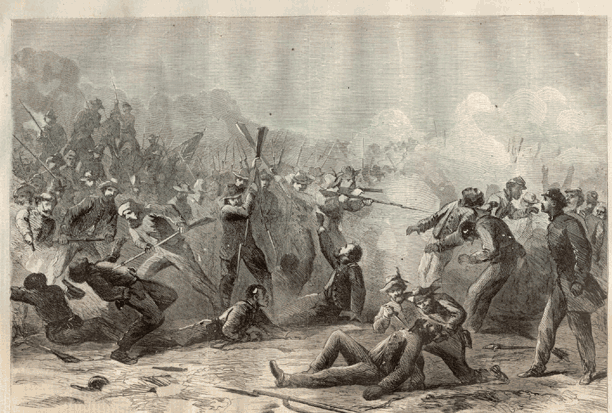
Seabrook’s book A Rebel Born is interesting for many reasons. For one, I can’t understand why anyone would want to defend a man like Nathan Bedford Forrest, who was so nasty that he couldn’t even get along with his fellow Confederates. Seabrook, however, is not alone among historians for embracing the man who promised recruits a “heap of fun” killing Yankees. The deceptively staid Shelby Foote admired Forrest. “The Most Man in the World,” as Foote called him, was a semi-literate slave trader who at one point threatened to kill his superior officer, Braxton Bragg. Forrest was a brilliant tactician, no doubt. But nothing he did decided the war one way or another. Forrest’s role in massacres at Fort Pillow and Brice’s Crossroads (or Tishomingo Creek) doesn’t brighten his reputation—personally or militarily–either. Forrest Gump, who was named after the general, is a cuddly fictitious character. Nathan Bedford Forrest was a not-so-cuddly thug.
The fiction writer Madison Bell wrote a strange novel, Devil’s Dream, about the very strange Forrest. It contains more sex than one would expect from a Civil War novel. I’m sure Seabrook sticks more to the facts, but one wonders if 800 pages is necessary in order to do that. In any case, Forrest represents the darker side of the Confederacy. And books like A Rebel Born are an outgrowth of the bizarre Right wing movement that has emerged in this country, especially in the South, in the last twenty years. This movement firmly defends the Second Amendment while it toys with discarding the 14th. It takes its form as the Tea Party and the Virginia Flaggers and Fox News. Academic historians don’t take books like A Rebel Born too seriously, except as another entry in the strange historiography of the Civil War. Yet, such books are out there on the shelves.
Seabrook’s writings on the Confederacy, oddly, have a readership that is likely on opposite ends of the political spectrum. The converted among the “heritage groups” will want to be preached to, while skeptics will look at A Rebel Born with disturbed fascination. I am among the latter. But, I’ll congratulate the author on one score: he got his book on the shelves of Barnes and Noble. That’s no easy task for anyone.
Colin Woodward is a historian and archivist. He is the author of Marching Masters, Slavery, Race, and the Confederate Army during the Civil War (University of Virginia Press, 2014). He is writing a second book on Johnny Cash.



 Colin E. Woodward's Official Site
Leave a reply to Andy Hall Cancel reply